
Summary:
The school calendar comes home in September. You flip to December, count the days, and that familiar feeling kicks in — not quite panic, but close. Two weeks. No school. Grandparents are available for maybe three of those days. The rest? Unaccounted for.
If you’re a working parent in Livingston, NJ or anywhere in Essex County, this is an annual reality. Winter break is one of the longest school-free stretches of the year, and unlike summer, there’s almost no infrastructure built around it. The options are thin, the good ones fill fast, and the cold weather rules out most of the usual fallbacks.
Here’s what to know before you start searching.
What Is a Winter Break Camp — and How Is It Different From Summer Camp?
A winter break camp, sometimes called a holiday camp or school break camp, is a structured drop-off program that runs during the weeks school is out in December and January. The format varies — some run a full week, some offer single-day sign-ups, some are half-day, some are full-day — but the core idea is the same: your child has somewhere purposeful to be while you’re at work.
What makes a winter break camp different from summer camp isn’t really the season. It’s the context. Summer camp has months of planning built around it. Winter break tends to sneak up on people, and the options in most suburban New Jersey communities are genuinely limited compared to what’s available in July. That scarcity is real, and it’s worth understanding before you start comparing programs.
What Do Kids Actually Do at a Winter Break Camp?
This is the question parents ask most, and it’s the right one to ask. “Fun activities” is not an answer. If you’re going to drop your child off somewhere for several hours during the holidays, you want to know specifically what their day looks like.
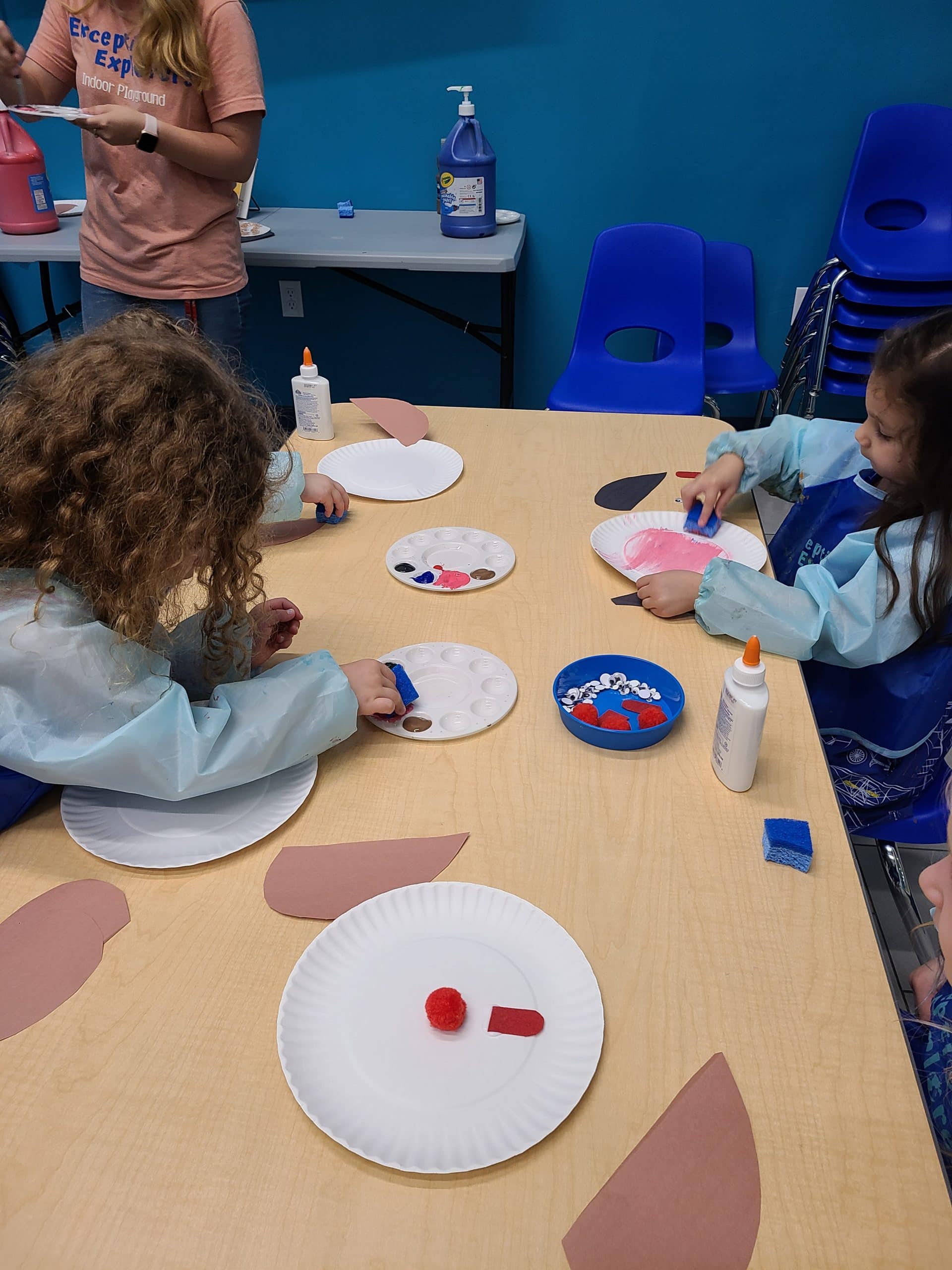
At a quality enrichment-based camp, a typical day includes hands-on arts and crafts with a theme, active time in a play space, structured social activities like board games with peers, and a snack. The emphasis is on engagement — not just keeping kids occupied, but giving them something to actually do with their hands, their imagination, and each other.
The social piece matters more than it might seem. Winter break is one of the few extended stretches where school-age children are largely cut off from their peer group. Structured camp time gives kids a chance to maintain those social rhythms — practicing turn-taking, building friendships, navigating group dynamics — during a period when those opportunities would otherwise disappear. Research from the American Camp Association consistently shows that children who stay socially active during school breaks transition back to the classroom more smoothly than those who don’t.
There’s also the screen time reality to consider. New Jersey winters are cold — December highs in Essex County hover around 43°F, January even lower — which means outdoor play isn’t a realistic daily option. Without structure, winter break has a way of becoming two weeks of devices by default. A camp with a real program is one of the few genuine alternatives.
The best programs balance active movement, creative work, and social interaction. If a camp can’t describe its daily schedule in specific terms, that’s worth noting.
How to Choose the Right Winter Break Camp for Your Child
Most parents start by searching for holiday camps or school break camps in their area and end up with a mix of municipal recreation programs, franchise studios, YMCA offerings, and smaller boutique spaces. They all look roughly similar at first glance. Here’s how to actually tell them apart.
Start with the staff. Who designed the program, and what are their qualifications? This question alone separates most camps quickly. A program built by licensed developmental professionals — an Occupational Therapist, a Speech Language Pathologist — is a fundamentally different product than one run by generalists with a craft supply budget. The activities may look similar on the surface, but the reasoning behind them and the staff’s ability to support children who need a little extra time to settle in is not the same.
Next, look at age fit. Not just the stated age range, but whether the programming is actually differentiated for your child’s developmental stage. A camp that lumps toddlers and eight-year-olds into the same activities isn’t really designed for either.
Ask about the drop-off format specifically. Some “camps” are really structured open play — a parent stays nearby. Others are true drop-off programs where your child is in the care of staff for the duration. If you need real coverage, you need a real drop-off program.
Flexibility matters too. Many families in Livingston, NJ have a mix of coverage during winter break — a few days with grandparents, a day trip, partial holiday travel. A camp that requires a full-week commitment loses a significant portion of families who could otherwise benefit from it. Single-day sign-up options are worth looking for specifically.
Finally, read the cancellation policy before you book. A program that publishes its cancellation terms clearly — what notice is required, what happens if your child is sick — is signaling something about how it operates. Transparency about the fine print is a small but real indicator of organizational quality.
Winter Break Camp Options in Livingston, NJ and Essex County
Families in Livingston, NJ have a handful of options when winter break arrives. The township’s Recreation Department runs a Kids’ Camp program for grades 1–6 at the Livingston Senior/Community Center — a low-cost, accessible option for basic coverage. The West Essex YMCA is another familiar name in the area. For enrichment-focused programs with developmental expertise behind them, the choices get narrower.
What’s largely missing from the local market is a camp that combines genuine developmental expertise with a thoughtful, themed program designed specifically for young children. That gap is exactly what we built Exceptional Explorers to fill.
Why Livingston, NJ Parents Are Looking for Something Different
Livingston is not a community that settles for “good enough” when it comes to their children’s development. With 72% of residents holding a bachelor’s degree or higher and a school district that consistently ranks among the strongest in New Jersey, parents here are paying attention to what their kids are actually getting out of an experience — not just whether they’re supervised.
That’s the standard we hold ourselves to at Exceptional Explorers. Our space was co-founded by two mothers from right here in Livingston, NJ — one a licensed Occupational Therapist, the other a Speech Language Pathologist. That’s not a marketing detail. It’s the reason our programs are designed the way they are. Every activity, every play structure, every element of our mini-camps is built around how children actually develop — motorically, socially, and linguistically — not just what looks fun on an Instagram post.
We’re located at 277 Eisenhower Parkway, Suite 12C — the Shoppes at Livingston Circle — which means we’re easy to reach from anywhere along the Eisenhower Parkway corridor, Route 10, or I-280. Families come to us from West Orange, Millburn, Short Hills, Maplewood, and across Essex County, often because they’ve exhausted the generic options and want something with more substance behind it.
Our mini-camps run during winter break and other school closure days, including MLK Day and Juneteenth. The format is a true drop-off program for children ages 4 and up who are toilet trained. A typical camp day includes themed arts and crafts, time on our multi-level indoor playground, board games with peers, and a snack — all in a clean, padded, enclosed environment that’s designed for this age group specifically. You can sign up for a single day or the full week, depending on what your schedule actually looks like.

Frequently Asked Questions About Winter Break Camp in Livingston, NJ
Parents ask us a lot of the same questions before booking, so it’s worth addressing them directly.
One of the most common: “My child has never done drop-off before — will they be okay?” This is a real concern, especially for children in the 4–6 age range attending their first structured drop-off program. Because our founders are a licensed OT and SLP, our staff is genuinely equipped to support children who need a gentle transition. We’re not just trained to run activities — we understand child development, and that shapes how we handle the first-day nerves that are completely normal for this age.
Another frequent question: “What if I can only do a couple of days, not the whole week?” You don’t have to commit to the full week. We offer daily sign-up options with 48 hours’ notice. Many Livingston families have partial coverage from family or planned holiday activities, and we built our booking structure around that reality rather than forcing a full-week commitment.
Parents also ask about age range, particularly when they have kids at different developmental stages. We serve children from 6 months through approximately age 10, which means siblings with an age gap can often attend together — something most local programs in Essex County can’t accommodate.
A few parents have asked whether sending their child to camp during the holidays means they’re missing out on family time. We’d push back on that gently. A structured, enriching camp experience — where your child is actively engaged, building friendships, creating things, and moving — is not a compromise. For many kids, it’s a highlight of the break. The guilt around holiday childcare is real and understandable, but it’s worth examining whether it’s actually grounded in your child’s experience or just a feeling.
Finally, on the question of what Livingston Public Schools’ winter break looks like: the district typically follows the standard New Jersey school calendar, with winter break running from approximately December 23 through January 3. That’s 10 or more consecutive school-free days. We’d encourage you not to wait until mid-December to start looking — our mini-camps have limited capacity, and spots go quickly once families realize the break is approaching.
Finding the Right Winter Break Camp in Livingston, NJ
Winter break doesn’t have to be a logistical scramble. The families who feel most prepared are usually the ones who looked into their options in October or November, asked the right questions about staff credentials and program design, and booked before the good spots were gone.
If you’re looking for a winter break camp in Livingston, NJ or Essex County that’s more than supervised downtime — one built by developmental professionals, designed for young children, and flexible enough to fit an actual family schedule — we’d love to have your child join us.
Reach out to Exceptional Explorers to check availability for the upcoming winter break. We’re happy to answer questions, walk you through what a camp day looks like, and help you figure out whether it’s the right fit for your child.