Summary:
It’s a cold Tuesday afternoon in Livingston, your toddler has already emptied every drawer in reach, and someone online says a bin of rice might buy you a quiet half hour. Maybe it will. It will also put rice in places you didn’t know you owned.
Most sensory bin ideas for toddlers are written as if mess doesn’t matter. Anyone who has vacuumed after one knows it does. So we’ll start with containing it, then walk through ten bins you can build from your kitchen cupboard, the safety lines worth knowing, and what to do if your child wants no part of it.
Sensory Bin Ideas for Livingston Parents Who Dread the Mess
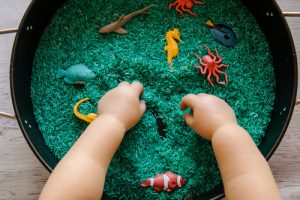
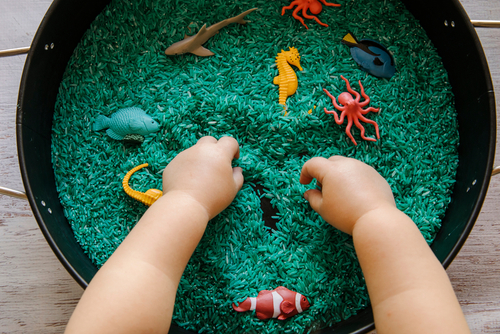
A sensory bin is a shallow container filled with something interesting to touch, plus a few tools to play with. That’s the whole formula: a base, something to scoop or pour with, and maybe a small toy to hide and find. A shoe-box-size tub works. So does a baking sheet with a rim.
What most guides skip is that the base decides how your afternoon goes. Dry, large, easy-to-sweep materials keep a living room manageable. Wet and sticky ones belong in the kitchen or the bathtub.
If you’ve avoided bins because you picture glitter-level chaos, that’s a fair instinct. We see the same thing at Exceptional Explorers in our Sensory Science class here in Livingston. Toddlers love getting their hands into everything, and parents enjoy it a lot more when the cleanup isn’t waiting at home.
How Do You Keep Sensory Bins From Making a Mess?
Start with where the bin lives. A rimmed baking sheet or a shallow storage tub set on a bath towel gives your toddler a clear play zone, and a second towel under the chair catches what escapes. A hard floor or the kitchen table beats the rug every time. Sit your child down before the bin comes out, not after.
Next, choose a dry base first. Dry fillers are the easiest for kids who dislike mess, and they sweep up in minutes. Stick to one material at a time. The more you pile in, the more there is to chase across the floor, and toddlers don’t need six textures at once to be completely absorbed.
Add two tools, say a scoop and a cup, and stop there. Then decide on your ten-minute cleanup before you begin. Keep a dustpan or handheld vacuum nearby and let your toddler help scoop everything back into the bin, which counts as play too. Dry rice and pasta can go straight into a lidded container and be used again several times, as long as they stay dry.
On a rainy afternoon in Essex County, some families will want the bin on the kitchen table with a high chair pulled up, and others will want the bathtub for anything wet. Both work. Just ask yourself where you’d rather clean up, and set the bin there. That one decision protects your sanity more than any particular filler does.
What Can You Put in a Sensory Bin From Your Kitchen Cupboard?
Here are ten sensory bin fillers you probably already own, roughly from least mess to most.
Large dry pasta in shapes like rotelle, fusilli, and rigatoni is the easiest first bin, since big pieces are simple to pick up and hard to lose under the couch. Dried corn kernels are another good dry base. Cereal puffs and pretzels add new sounds and textures. Cranberries floating in a bowl of water worked well for one parent blogger, whose toddler stayed focused for up to 15 minutes with almost no help.
If you’re up for a little prep, rainbow rice is the classic. Put 1 cup of dry rice in a bag with 1 tablespoon of white vinegar and 1 teaspoon of food coloring, shake it, and spread it on a paper-towel-lined baking sheet to dry overnight. Oats or cornmeal give you a soft, sandy texture that plays like cloud dough.
For a change of pace, mix equal parts cornstarch and baking soda and add water slowly for cool, snowy squish. Soap foam is 2 tablespoons of dish soap and a quarter cup of water, blended until fluffy. It’s for touching, not tasting, so stay close. Ice cubes with measuring cups, spoons, and a little water might be the simplest bin of all.
Coffee grounds smell wonderful and are fun to scoop, but check for allergies and choking risk first, and leave birdseed for older kids who no longer mouth things. Skip raw dried beans for any child who still tastes everything.
Sensory Activities for Toddlers: Safety Rules Parents in Livingston Ask About First
Safety matters more than variety here. Sensory bins are a good fit for children over 18 months. For younger babies, the hazards tend to outweigh the benefits. That doesn’t mean a one-year-old misses out. It means the setup changes.
Fill a bag with something squishy and seal it so your baby can press and pat it without being able to pick anything up or put it in their mouth. Keep your hands close the whole time.
For everyone else, the rules are short. Stay with your child. Use nontoxic materials. Keep the pieces large. Never force a child to touch a texture. These are the same points we stress at Exceptional Explorers, and they’re why we require adult participation in our Sensory Science class.
Are Sensory Bins Safe for Toddlers Who Put Everything in Their Mouths?
It depends on the age, the filler, and how close you are. A 20-month-old who tastes everything can still enjoy a bin, but the bin has to be built for a taster. That’s why cereal puffs, big pasta shapes, and cranberries earn their spot, and why small beads, loose seeds, and coffee grounds don’t. Keep pieces large and your attention on the bin, not your phone.
Allergies deserve a minute too. Food-based bins can include wheat in pasta, flour, and cereal, plus nuts and other ingredients you might not think of, so read every label before anything goes in a bin. If using food as a toy bothers you, and it bothers plenty of parents, a non-food base like large plastic or wooden items works fine. Reusing dry materials a few times also cuts the waste.
Parents here in Livingston tend to ask us about safety before anything else, which makes sense. You’re probably weighing it the way you’d weigh any choice for your kid, with questions and a bit of research. Our space on Eisenhower Parkway has a separate toddler zone, and reviewers often mention how clean it is and how attentive our staff are. If you want to watch how a bin is handled before you try one at home, our Sensory Science class is led by an experienced science teacher with a parent beside every child.

What If My Toddler Hates Messy Play?
Then you’ve got a toddler with opinions, not a problem. Not every child loves messy play, and nobody should force it. Start with a dry base, hand your child a spoon so their fingers stay clean, and let them watch you touch it first. Some kids will warm up in ten minutes, some in a month.
Sensory play can be adapted for both sensory-sensitive and sensory-seeking kids, so there’s a version for yours. Here’s something most bin guides leave out: you can turn bin time into talking time. Describe what’s happening (“You’re pouring the rice”), describe what your child is doing, offer a choice (“Big scoop or little cup?”), and then wait a few seconds. That pause is where toddlers try out words.
Our curriculum was designed by a Speech-Language Pathologist and an Occupational Therapist, and these same simple moves come home with parents as carryover ideas after each class. Expect short sessions, too. Five to fifteen minutes is a good run for a toddler, and one bin won’t change behavior overnight. Benefits build with repetition.
If you’d like to try this with company, our Sensory Science class gives toddlers hands-on experiments with a teacher leading, a parent joining in, and open play before or after. For families around Livingston and Essex County, it’s a rainy-day option with the mess left at our door.
Sensory Play Ideas for Toddlers in Livingston, NJ: Where to Start
Start small. Pick one dry base, put it on a tray, give your toddler a scoop and a cup, and plan your ten-minute cleanup before you begin. Keep pieces large, stay close, and wait until after 18 months for open bins, using sealed bags before that. If your child isn’t into it, step back and try again another day.
You don’t have to figure all of this out alone. If you’d rather see it done first, or just want a place to be on a day that’s too cold or rainy to go out, reach out to Exceptional Explorers at our Eisenhower Parkway location in Livingston. We’ll point you to the Sensory Science class or open play, and you can leave the cleanup to us.